Saturday, November 10, 2012

WHY DO YOU THINK THEY'RE CALLED "GREAT" LAKES? Part Five Lake Ontario

Fed by Niagara Falls, last of the Great Lakes chain, Lake Ontario carries all the waters of the Great Lakes 193 miles east into the St. Lawrence River. More than seven hundred miles later, all that water ends up in the Atlantic Ocean. 

Smallest of the Lakes, the name Ontarío means “Lake of Shining Waters” in the Huron language. The Canadian Province took it's name from this Lake and over nine million people live along the Canadian shore––almost a quarter of Canada's population. The US shoreline is more rural, except for the city of Rochester, New York.

The first European to explore Lake Ontario was Étienne Brûlé  (another Frenchman with an interesting life if you care to click on his name), though there are claims of Norse artifacts found in the area of Sodus Bay in New York.
http://en.wikipedia.org/wiki/Lake_Ontario


When I googled Lake Ontario to research this post, four of the first eleven hits were about fishing. Apparently Lake Ontario was once a prime source of Atlantic Salmon but was fished out by 1900. Now it is well stocked with Chinook "King" Salmon, Coho and Atlantic Salmon, along with other species of fish every year.  Photo Gallery   

I cannot write any piece about Lake Ontario without a mention of the Thousand Islands. And yes that's where the salad dressing got it's name. This archipelago of over 1800 islands begins at the eastern end of Lake Ontario and extends into the St. Lawrence River. These islands of all shapes and sizes brought the wealthiest of New Yorkers and Canadians to build everything from the tiny cottage to castles on their shores. There are so many islands that ships hire local maritime pilots to guide them through the rocks and shoals. 


Aerial view of w:Boldt Castle and some of the w:Thousand Islands in the w:Saint Lawrence River by Teresa Mitchell

From Duluth, Minnesota to Watertown, New York, my series on the Great Lakes has taken us past eight US states and the Province of Ontario.  Hope you all enjoyed it. Your comments are always appreciated.

Vivian :)


Wednesday, October 31, 2012

GREAT LAKES MAKE WEATHER CHANNEL'S TROPICAL UPDATE?

Hurricane Sandy 
Our thoughts are with the people on the East Coast who were hardest hit by this superstorm.

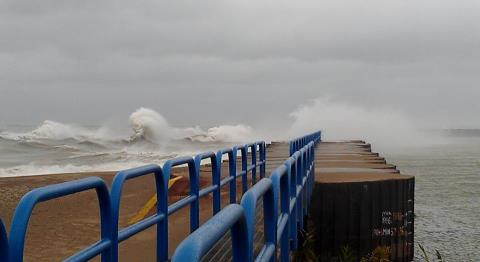
Never thought I'd see the day when the Great Lakes made the Weather Channel's Tropical Update and Hurricane Central, but Sandy was 900 miles wide. Her swath hit from New York and New Jersey all the way to Chicago and north to the Arctic Circle. Her fringes spawned 74 mph winds kicking  the Great Lakes into waves two stories high that called a halt to shipping for two days.  

11am Update on Post Tropical Cyclone Sandy

Below are some links to Hurricane Sandy's affect on the Great Lakes.  

Lake Michigan waves in Chicago 
Lake Michigan 32 Ft. waves 
Lake Michigan storm surge
Chicago lake front
Great Lakes shipping
Lake Huron shipping
Lake Huron waves Sarnia Ontario


WINDS KICK UP HUGE WAVES ON LAKE HURON
Port Sanilac - Oct 29, 2012 -- Don-Sharon Frisch 
Great slideshow at WNEM Mid Michigan TV
Superstorm Sandy makes its mark on Mid-Michigan 


We live in interesting times. :)

Vivian

Wednesday, October 10, 2012

WHY DO YOU THINK THEY'RE CALLED "GREAT" LAKES? Part four, Lake Erie


Throughout most of the 17th century the Iroquois tribes settled along Lakes Erie and Ontario prevented exploration of the the lower lakes. These fierce warriors meant torture and death to any Frenchmen who tried to pass through. Instead explorers used the rivers out of Lake Ontario and portaged into Lake Huron sending new explorations North to Lake Superior. It was not until 1669 that Louis Jolliet explored Lake Erie.

There are thirty one islands in Lake Erie from the island village of Put in Bay Ohio, known as a "party" island for young people, to the Canadian Pelee Island where there is a "fragile and unique ecosystem" with plants rarely found in Canada, and two endangered snakes, to Kelley's Island which offers beaches and hiking and biking and glacial grooves left in the limestone. There are also reports of a Lake Erie Monster seen in its waters. :)
http://en.wikipedia.org/wiki/Lake_erie

At an average depth of only 62 feet, winds over Lake Erie quickly kick up strong waves and storm surges, leaving the Lake's floor littered with shipwrecks, that are perfectly preserved in the salt free, cold water.


Erie carries the waters of Superior, Michigan, and Huron eastward across three states, and 241 miles later all that water suddenly plunges 173 feet into Lake Ontario, at a place called Niagara Falls. The most powerful waterfalls in North America, Niagara shrouds itself in a perpetual mist and rainbows. Expect a bad hair day if you ever visit them. 

At number six on Travel and Leisure's list of the World's Most-Visited Tourist Attractions, Niagara Falls' annual 22.5 million visitors beats out the Grand Canyon, all the Disney World Parks and even the Eiffel Tower in Paris France for tourists. 

Niagara is a spectacular sight and even the photos below cannot do it justice, so check out this link to a video of the Maid of the Mist––boats that carry tourists to the foot of the Falls. 
Niagara Falls Maid of the Mist  Thanks fiftytwopence.


Photo by Pluma of Niagara Falls from the Canadian side––Horsehoe Falls  


Vivian


Friday, September 28, 2012

WHY DO YOU THINK THEY'RE CALLED "GREAT" LAKES? Part Three, Lake Huron


Welcome to Michigan's "Sunrise Side"––The shores of Lake Huron. Much quieter and just a teensy bit nicer than the heavily traveled shores of Lake Michigan––Lake Huron is where you go for true relaxation. Walk its sandy beaches for miles, enjoy a bonfire on the beach, and it begins to feel as if you have its entire 3,827 miles of coastline to yourself.

The residents like it this way, so I'd appreciate you not telling anyone about this gem of a Great Lake, please. : )

The early French explorers called this body of water La Mer Douce or Fresh Water Sea, though it was called "Lac des Hurons" on their early maps. It is 183 miles from the Michigan shore to the Canadian side. Huron carries the waters of Superior and Michigan, from the Straits of Mackinac, 206 miles south, where it suddenly narrows into the St. Clair River at Port Huron Michigan (a great place for ship watching). From there it flows into beautiful Lake St. Clair, then into the Detroit River and on into Lake Erie.
http://en.wikipedia.org/wiki/Lake_Huron


Lake Huron

I could mention where this is. But then everyone would know 

Under the Blue Water Bridge to Canada, ships enter the St. Clair River at Port Huron

Lake St. Clair boat traffic for Detroit's 300th Anniversary July 2001

Sharing the channel on Lake St. Clair


Vivian : )

Friday, September 21, 2012

WHY DO YOU THINK THEY ARE CALLED "GREAT" LAKES? Part Two, Lake Michigan


Once again a Frenchman is credited with discovering a Great Lake. Searching for a "South Sea" to the Far East Jean Nicolet left Quebec in July of 1634 with seven Hurons paddling canoes. Lake Michigan must have seemed like an ocean to Jean, because by the time he arrived in Green Bay Wisconsin that Autumn he was convinced he was about to meet some exotic Far Eastern peoples. Trying to make an impression he dawned flowing robes and announced himself by firing pistols into the air ... but all he did was frighten a few members of the native Indian tribes. 
http://www.ci.green-bay.wi.us/history/1600s_1700s.html


Today, twelve million people live along Lake Michigan's 1600 miles of shoreline. Because of it's many sandy beaches it's often call the nation's "third coast", attracting millions more tourists every summer. 

Noted for vibrant sunsets, spectacular sand dunes, and the City of Chicago––Michigan is perhaps the most well known of the five Great Lakes. Stretching from the Straits of Mackinac at the tip of Michigan's mitten, more than three hundred miles south to Chicago Illinois, it is the only Great Lake contained entirely within US borders. Four states line its shores, including Wisconsin and Indiana.


The ferry boat SS Badger departing Manitowoc Wisconsin for the 118 mile trip to Michigan

Even a colorful character like Jean Nicolet would be awed by the lake he discovered. 

Vivian


Sunday, August 26, 2012

WHY DO YOU THINK THEY'RE CALLED "GREAT" LAKES? Part One, Superior


The Oxford American Dictionaries defines the word "lake" as a large body of water surrounded by land. Obviously the Oxfords have never been to Michigan. I mean there's large bodies of water surrounded by land ... and then there's sweet water seas, as the early French called the Great Lakes. 

The two peninsulas of Michigan, surrounded on three sides by Lakes Superior, Michigan, and Huron, give the state more coastline than any other in the US, except Alaska.

The Great Lakes system begins with Lake Superior in the far North. Fifty three rivers feed its 31,700 sq. miles of surface water, the combined area of several small US states. Beginning in Duluth Minnesota, Superior ends 350 miles east, at the St. Mary's River, and the City of Sault Ste. Marie MI, where the Soo Locks control more than a twenty foot drop into Lake Huron.
http://law2.umkc.edu/faculty/projects/ftrials/superior/superiorfacts.html
http://en.wikipedia.org/wiki/Category:Tributaries_of_the_Great_Lakes
http://www.enchantedlearning.com/usa/states/area.shtml

Split Rock Lighthouse, Silver Bay, Minnesota
Duluth Minnesota, photo by Jakes18

Ice on North Shore of Lake Superior in Minnesota taken by Jeff Gunderson http://epa.gov/greatlakes/image/vbig/495.jpg


December, 1999, the motor vessel Oglebay Norton passes safely through the St. Marys River after Coast Guard icebreakers did their job earlier on the river  http://en.wikipedia.org/wiki/File:St_Marys_River_winter.jpg  

A one thousand foot freighter inches into one of the Soo Locks


Since the French sailing ship Le Griffon, vanished in Lake Michigan in 1679, to the seven hundred foot freighter, Edmond Fitzgerald, lost during a storm on Superior in 1975, there are almost five thousand shipwrecks lying at the bottom of the Great Lakes. Shipwreck tours and museums abound in Michigan. 


Just imagine taking on a lake the size of Superior in a canoe, as the early French explorers did.               

Vivian


Friday, August 10, 2012

WHY NO ONE EVER TRULY CONQUERS THE FRENCH

The French first settled along the Detroit River in 1701. Sixty years later, Detroit was lost to the British and after the American Revolution it became part of the United States. Immigrants from all over the world flooded the region until French was no longer heard on the streets of Detroit. 

Yet those first French settlers are not gone. Their names dot the street map of modern Detroit––Beaubien, Campau, St. Aubin, St. Antoine, Charlevoix, Dequindre, Navarre, and hundreds more. Their 10th great grandchildren still carry their French names.

On the Canadian side of the Detroit River, many still speak French. According to Wikipedia, River Canard Ontario just south of Windsor, "... is home to one of the last vestiges of the French-speaking inhabitants of the Detroit River Region..." http://en.wikipedia.org/wiki/River_Canard,_Ontario

And the Virtual Museum of Canada claims that, "... vestiges of ancient eras remain, echoes of old Détroit that can still be heard in the folklore that was handed down through oral tradition for more than three hundred years." Who Are the Detroit River French?  
Occasionally the strange tales of the old French rise up to the streets of Detroit too, as every spring Detroiters are Chasing the The Nain Rouge From Detroit.
No one ever truly conquers the French. 
Vivian