Showing posts with label Detroit River. Show all posts

Monday, April 22, 2013

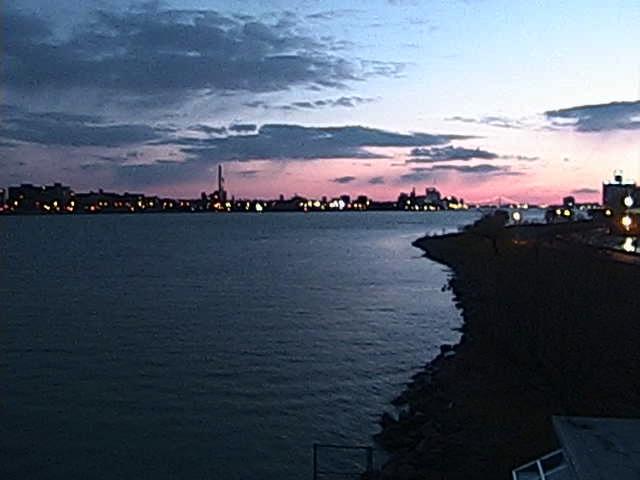
DETROIT MICHIGAN DUSK


Happened to catch the webcam on Belle Isle at just the right moment last Saturday evening. My thanks to The Dossin Great Lakes Museum, and the Detroit Historical Society for these great photos. 
http://detroithistorical.org/dossin-great-lakes-museum/detroit-river-watch-webcam

Ambassador Bridge to Canada. Windsor Ontario is on the left.


The Detroit River makes a sharp bend toward the West. This makes Detroit the only place in the US where Canada is to the South. If you're doing genealogy research about the old French settlers don't be confused. If the records state birth or death place as the South shore, they are referring to the Canadian side of the river.


Vivian :)


Friday, March 15, 2013

MY MOTHER WAS RIGHT


Remember being a kid––a teenager old enough to remember things?  Remember how your mom or dad told you stories about the past, and being a teenager you automatically dismissed their stories because… well just because. They were your parents after all, ancient as far as you were concerned, and befuddled by all that was new. You figured they must have dreamed up these stories about the past. 

Growing up near Detroit our family often crossed the Candian border to visit my mother's family near Windsor, Ontario. We always passed a certain house on the road. My grandparents had lived there… eons before, but Mom always told me the same story about that house. My Irish Great Grandfather, his  American wife and three daughters, lived in that home for a time, when he worked for a salt mine nearby. 

One day a horse drawn wagon loaded with vegetables passed by that house, headed for the ferry boat and the farmer's market in Detroit. The youngest daughter flagged down the driver hoping to buy some vegetables. She ended up married to that French Canadian farmer and they had three daughters of their own. The oldest was my Mother. 

It was the story of how I might have been a Canadian, but my mind was only concerned with the Beatles song playing on the car radio. 

When Mom said my French Grandfather's ancestors were farming along the Detroit River three hundred years ago, that they lived there with the Indians, I laughed.

There was the story of how Mom became a replacement blind date. It was an outing set up by a mutual friend of my father. Her sister was supposed to go but she fell ill at the last minute. It was the Great Depression and few people had phones, so Mom was recruited to fill out the quartet. My mother went along in her sister's stead to meet the young stranger waiting at the other end of the Detroit-Windsor Tunnel. A year later they were married, and I was born an American.

There were other stories––a cousin who worked at the Pentagon for many years, my paternal Grandfather's successful upholstery business. And there were babies –– babies that died of Diphtheria and influenza, of food poisoning due to lack of refrigeration, a sister killed by an accidental gunshot. I heard the stories but they did not penetrate my frivolous teen aged heart. 

It wasn't until I threw a high school graduation party for my own daughter, that I gave a second thought to Mom's stories. My daughter asked me who all those well wishers were at our house. I could name the first even the second cousins, but then she wanted to know more. At eighteen, her mind was far more curious than mine and we began to gather family information.  

My parents were gone by then. My mother and grandmother's photo albums contained people I did not recognize. I recalled the many names Mom mentioned over the years but I'd no idea how or if we were related. 

We had the internet though, and we began to research, amazed at how many others were seeking their family too.  Our family website was contacted by my mother's cousin––the man who worked at the Pentagon. We met with him, and this time I listened to the stories––Stories about that Irish Great Grandfather, stories about the fun times he'd had visiting my mother's farm as a child. Even at ninety years old he could identify many of our old photos. He was in several of them. 

Then a kindly Canadian saw our family website. My 5th cousin, he sent me a database of 1500 names gleaned from church records in Windsor and Quebec. I sat up all that night totally spooked as generation after generation clicked by on the computer screen.  My mother was right, her French Canadian family not only went back to the beginning of Detroit, they went back to the first settlers in North America. One of them was an interpreter of Indian languages. 

Historical research proved that yes there was a Windsor Salt company near Windsor at the turn of the 20th century. And a business card in my mom's things confirmed my grandfather's Detroit upholstery business. 

I told the story of my parent's accidental blind date to my cousins (children of the ill sister) and our minds boggled with what ifs. 

I stared at the headstones of children lost in infancy, of a sister lost to a misfired gun, and felt my ancestor's loss, as I thanked God for the life we have today. 

My mother was right, right about everything. In my mind I've apologized many times for dismissing her stories. I just wish she was here now. There are still so many questions. 


Tuesday, January 22, 2013

A COLD TUESDAY ON THE DETROIT RIVER


My home thermometer, the one tucked under my warm kitchen window, reads four degrees as I enjoy my morning coffee. The Dossin Great Lakes Museum webcam shows ice flows on the Detroit River. I don't see any ships, though the Boat Nerds map reveals some local tugs, along with US and Canadian Coast Guard boats. One freighter, the Arthur M. Anderson, now on Lake Erie near Toledo Ohio, claims their destination as "home sweet home" and who can blame them. I wouldn't want to be outside today. 

But in spite of the cold life goes on along the Detroit River. Freighters plow through the ice sheets forming on the Lakes, trucks are crossing the Ambassador Bridge, steel mills and factories spew smoke into the blue skies over Detroit, and the towers of the GM building shine in the morning sun. 

It's that midwestern work ethic I guess. :)

Vivian


Wednesday, January 2, 2013

THIS MORNING ON THE DETROIT RIVER

Only seventeen degrees this Wednesday morning January 2, 2013 and the Detroit River looks slushy, but shipping continues on the Great Lakes and I wanted to share these new photos. 

These photos were taken from the Detroit River Webcam at the Dossin Great Lakes Museum on Belle Isle. Check out http://Boatnerd.com/ to discover all things Great Lakes, and do a search on webcams for more great views.


Vivian :)

Thursday, December 27, 2012

GREAT LAKES WEBCAMS


I didn't have to leave the comfort of my home to get these great photos. Recently discovered webcams located at my favorite places around Michigan and thought I'd share them with any Great Lakes and Boat Nerds out there. I grabbed these from the Dossin Great Lakes Museum webcam on Belle Isle, an island in the Detroit River. 


Captured this freighter as it passed Belle Isle


The photo below came from the Soo Locks webcam in Sault Ste. Marie, located in Michigan's Upper Peninsula.


Then there's the Mackinac Bridge Webcam.

http://www.mackinacbridge.org/bridge-cam-20/

And we can thank http://ais.boatnerd.com/ for this Great Lakes & Seaway Shipping Online and Vessel Passage Map.


Enjoy,
Vivian :)


Friday, September 28, 2012

WHY DO YOU THINK THEY'RE CALLED "GREAT" LAKES? Part Three, Lake Huron


Welcome to Michigan's "Sunrise Side"––The shores of Lake Huron. Much quieter and just a teensy bit nicer than the heavily traveled shores of Lake Michigan––Lake Huron is where you go for true relaxation. Walk its sandy beaches for miles, enjoy a bonfire on the beach, and it begins to feel as if you have its entire 3,827 miles of coastline to yourself.

The residents like it this way, so I'd appreciate you not telling anyone about this gem of a Great Lake, please. : )

The early French explorers called this body of water La Mer Douce or Fresh Water Sea, though it was called "Lac des Hurons" on their early maps. It is 183 miles from the Michigan shore to the Canadian side. Huron carries the waters of Superior and Michigan, from the Straits of Mackinac, 206 miles south, where it suddenly narrows into the St. Clair River at Port Huron Michigan (a great place for ship watching). From there it flows into beautiful Lake St. Clair, then into the Detroit River and on into Lake Erie.
http://en.wikipedia.org/wiki/Lake_Huron


Lake Huron

I could mention where this is. But then everyone would know 

Under the Blue Water Bridge to Canada, ships enter the St. Clair River at Port Huron

Lake St. Clair boat traffic for Detroit's 300th Anniversary July 2001

Sharing the channel on Lake St. Clair


Vivian : )

Friday, August 10, 2012

WHY NO ONE EVER TRULY CONQUERS THE FRENCH

The French first settled along the Detroit River in 1701. Sixty years later, Detroit was lost to the British and after the American Revolution it became part of the United States. Immigrants from all over the world flooded the region until French was no longer heard on the streets of Detroit. 

Yet those first French settlers are not gone. Their names dot the street map of modern Detroit––Beaubien, Campau, St. Aubin, St. Antoine, Charlevoix, Dequindre, Navarre, and hundreds more. Their 10th great grandchildren still carry their French names.

On the Canadian side of the Detroit River, many still speak French. According to Wikipedia, River Canard Ontario just south of Windsor, "... is home to one of the last vestiges of the French-speaking inhabitants of the Detroit River Region..." http://en.wikipedia.org/wiki/River_Canard,_Ontario

And the Virtual Museum of Canada claims that, "... vestiges of ancient eras remain, echoes of old Détroit that can still be heard in the folklore that was handed down through oral tradition for more than three hundred years." Who Are the Detroit River French?  
Occasionally the strange tales of the old French rise up to the streets of Detroit too, as every spring Detroiters are Chasing the The Nain Rouge From Detroit.
No one ever truly conquers the French. 
Vivian

Wednesday, June 27, 2012

DETROIT, 311 YEARS OLD


The City of Detroit celebrates 311 years of settlement this July 24th. 

As a child, growing up near Detroit, I thought the river that ran between Lake St. Clair and Lake Erie had always been lined with smokestacks, factories, mountains of coal, and warehouses. Eventually, genealogy sparked an interest in the history of Detroit.

Research led me to the Clark Historical Library's exhibit, "I arrived in Detroit" and Antoine de la Mothe's 1702 Report describing the Great Lakes and his new settlement at Detroit.

It is difficult to imagine the Detroit River in 1702.  Who would have thought fruit trees and grapevines once grew wild along its banks and that eventually it led to a prairie where bison, or wooly oxen as he called them, grazed. 

"On the banks and round about the clusters of timber there is an infinite number of fruit trees, chiefly plums and apples. They are so well laid out that they might be taken for orchards planted by the hand of a gardener.


On all sides the vine is seen; there are with some bitter and rough grapes, - others whose berries are extremely large and plump. There are also white and red grapes, the skins of which are very thin, full of good juice."

"But 15 leagues from Detroit, at the entrance to Lake Erie, inclining to the south-south-west, are boundless prairies which stretch away for about 100 leagues. It is there that these mighty oxen, which are covered with wool, find food in abundance."

Grapevines and apple trees? Tall grasses with bison?  I thought about this description as I looked for a book cover.


The closest I could find to what Cadillac might have seen was the Nature center at Lake St. Clair Metropark, a marshland, and forest, and beautiful place to visit any time of the year. 

http://www.metroparks.com/metroparks/blog.aspx?ID=7

South of the lake, on the other side of the Detroit River in Windsor Ontario, is  the Ojibway Prairie Provincial Nature Reserve. I've made a note to visit there soon. It appears to have the tall grass prairie that Cadillac spoke of but sadly no buffalo. 


Detroit-River Nature-Preserve
Below are some photos of the Detroit River today. I snapped these from the Canadian side during a visit to Windsor Casino.
 

Detroit-River from Windsor-Casino
Detroit River facing North, as it surrounds Belle Isle


Detroit-River Freighter
Freighter heading south, down river


Detroit-River Detroit-Skyline
Detroit's Renaissance Center, now GM Headquarters, and downtown

http://en.wikipedia.org/wiki/File:Fireworks_DetroitWindsorIntlFreedomFest.jpg
Thanks to Vito Palmisano for this great photo

Amazing what 311 years can do to a place.

Vivian


Friday, June 15, 2012

ISLANDS OF THE DETROIT RIVER


 Mikerussell@wikipedia.org 
Looking over the map I posted below, I began to understand why I enjoy researching the Detroit River French. I like their modesty, their simple lack of vanity.

Modesty? There's a word we don't hear in these days of narcissistic celebrities and self glorifying social media. But the Detroit River French were a modest people––practical, hardworking, and down to earth as the river they settled. No ego on the banks of the Detroit River, not in 1701.

Detroit's founder, Antoine de la Mothe Cadillac, a minor aristocrat, adopted many different names and titles to further his personal advancement. He had a grand plan for a new fur trading post on the Detroit River, yet he did not name his settlement Cadillac. He called it Fort Pontchartrain after the French Count who helped him gain funding for his mission from the King of France.

No one claimed the glory of discovering the Detroit River by giving it their own name. It was always called Rivière du Détroit, or River of the Strait. And that is exactly what the river is, a narrow, channel of water that connects two larger, bodies of water, Lake St. Clair and Lake Erie.

The French habitants named all their surroundings for just what they were. North of the fort was Presque Isle, (almost an island) and the Grand Marais (big swamp). In the river lay Isle de Cachon. Named Hog Island, because they used pigs to trample the many snakes there, today it is Belle Isle (beautiful island). Farther south on the river was Isle de Dindes (Turkey Island). The largest island was called Grosse Isle (Big Island).

There were few claims of glory among the first habitants of Detroit, at least for themselves. In their eyes only God deserved glory. French mapmakers called the northern lake that fed the river Mer Douce or sweet sea, until the French explorer René Robert Cavelier named it Lac Sainte-Claire in 1679. St. Anne de Detroit Church, the first log building in their settlement, was named after Ste. Anne, whose feast day fell on the date they landed in Detroit.

The hearts and struggles of Detroit's first settlers always belonged to God.


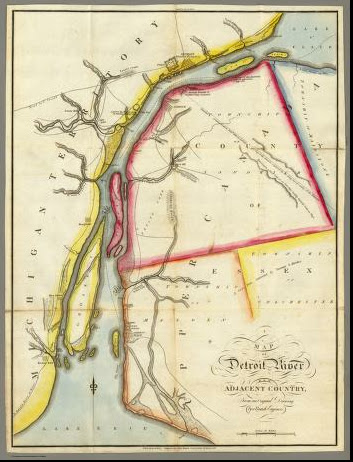
Click the link below to enlarge and explore a great map of the  Detroit River from 1812. Though it was made by a British engineer you can still see many of the old French names, from River Rouge (Red River) to Bois Blanc Isle (White Wood). 

And if you like historic maps check out the David Rumsey Map Collection at: 

David Rumsey Map Collection

There is also an excellent Wikipedia article listing all the islands of the Detroit River. I count twenty eight. How about you?


Saturday, June 2, 2012

SISTERS ON THE BORDER OF DETROIT HISTORY, ASSUMPTION CHURCH IN CANADA AND STE. ANNE DE DETROIT, USA


Image from: Wikipedia.org

The twin steeples of Ste. Anne de Detroit Catholic Church, and the gothic pinnacles of Our Lady of the Assumption Church, are like two sisters looking at each other across the jade current of the Detroit River. They are the grande dames of French Detroit.  

My grandparents were married at Assumption Church in Windsor Ontario and so it's always been special to me. Assumption is the slightly younger sister that's held up well these last two hundred and eighty four years. Surrounded by a campus of trees and gardens today, this parish was established in 1728 as a mission to the local native tribes, and was first called, "The Mission of Our Lady of the Assumption among the Hurons of Detroit."

In 1765 the mission grew to include the French settlers on the south shore of the river and was renamed, Parish of Our Lady of the Assumption. A frame church was erected near the river in 1767 and in October of that year a new Register of Baptisms and Marriages was opened.

The cornerstone of the current church was laid in 1842 on land donated by the Hurons. Since then the original French settlers were joined by people from around the world, and Assumption Church Windsor remains an important part of the community. It is the oldest continuous parish in Ontario.

I found the information for this post at the Assumption Church website.

http://www.assumption.rcec.london.on.ca/history.html

There is also a webpage for donations toward the preservation of this very special church.

http://assumptionheritagetrust.org/

And, if you'd like to see some wonderful photos of Assumption's interior:

http://www.internationalmetropolis.com/2008/10/01/assumption-church/

Vivian  
http://amzn.to/zVsVDZ


Tuesday, May 1, 2012

DETROIT MICHIGAN AND WINDSOR ONTARIO AT WAR?

Hard to imagine today, but yes it's true. Ever hear of the War of 1812?


And, here's a great history book about the Detroit River region during the War of 1812. It covers the peoples, politics, and culture, as well as historical events.
A Wampum Denied: Procter's War of 1812 by Sandy Antal.


I've added it to my reading list at Goodreads.
http://www.goodreads.com/author/show/5774053.Vivian_LeMay