Showing posts with label New France. Show all posts
Showing posts with label New France. Show all posts
Tuesday, February 11, 2014
THE LAST LORD OF PARADISE, COMPLETE SERIES


Tuesday, July 16, 2013
VACATION AT MACKINAC PART I

The Straits of Mackinac
The Straits of Mackinac must be one of the most photographed places in the world. Yet no two photos are ever quite the same. Sunlight, clouds, mist, wind, change the scene from moment to moment, and tomorrow will seem entirely different from today. That's why people return year after year to the same park bench by the Mackinac Bridge.

Everybody's favorite bench. Best place in the world to just sit and take in an awesome view.
Had a great vacation at the Straits. Discovered some new places and events. Started with Engineers day at the Soo Locks, toured Michilimackinac again, found the Fr. Marquette Memorial in St. Ignace, and the Forty Mile Point Lighthouse on Lake Huron. Took hundreds of photos but don't worry, I'll only post the best ones here at The Last Lord of Paradise, starting with the good old Big Mac Bridge and Colonial Michilimackinac.


Always changing

Lilacs in July. Mackinac has the perfect climate and soil for growing Lilacs.
One more thing I love about the Mackinac area is its long history. From the Colonial Fort Michilimackinac, set on the archeological digs of the original French fort built 1718––to Fort Mackinac on the Island, built by the British in the late 18th century, it's authentic history.



Michilimackinac gardens
British soldier
 |
| Apothecary Rose, has an interesting history and a delightful old rose scent. |
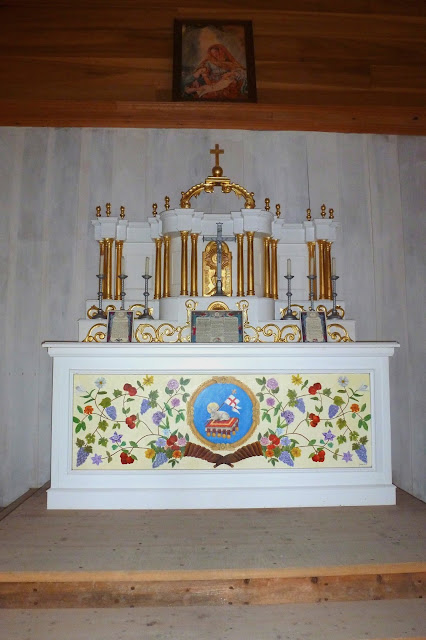
Ste. Anne de Michilimackinac Church
Bake oven


Today's treat, cow tongue stew.

Though I've been there many times, there's always something new to learn at Colonial Michilimackinac.
The Forty Mile Point Lighthouse and New France Discovery Center were pleasant surprises, and the Soo Locks Engineers Day...a Boat Nerd's dream. (Took a great video.) Will post more soon. Thanks for stopping by.
Vivian :)
Thursday, February 14, 2013
THE JESUITS, AND MY OLD PEAR TREE

The apples we soon discovered were riddled with worms. No matter how much or how often we sprayed those apple trees, we could not defeat the little buggers. Apples fell to the ground, deformed and inedible––food for the birds and bees and insects, until we raked them into a garbage bag and sent them to the curb on trash day. Then the plum tree was overtaken by some kind of grasshopper and had to come down.
The pear tree however, was awesome. Not a bug to be found. Withstanding Michigan's extreme heat and cold, without spray, extra water or fertilizer or pruning, it bloomed into white blossoms that produced bushels of tasty ripe pears every August.
We left that house many years ago, but after researching my Last Lord of Paradise book series about the early Michigan French, I started thinking about that pear tree. Could it have been a descendant of the Jesuit Pear trees––Trees planted more than 200 years ago by Jesuit priests with seeds brought from France? Some experts call the Jesuit Pear trees a legend, they say that the orchards were simply planted by the French habitants...But others do not agree.
According to an article in Botanical Electronic News from 2008, Cultivated Pears in Canada: Past & Present, the first pear trees in North America were planted by Jesuits.
"Pears originated in Asia, and are believed to have been cultivated for thousands of years. Although three species are cultivated in Canada, there are no native North American species. The "Common Pear," Pyrus communis, was introduced during the very early stages of settlement. The first trees were planted as crops in the early 1700s in the eastern Canadian wilderness. These early pears came from France and are now called "Jesuit Pears" or "Mission Pears" because they were planted by Jesuit priests in orchards at the missions and forts in Nova Scotia, Prince Edward Island, along the St. Lawrence River, the Niagara River and particularly along the Detroit River."http://www.ou.edu/cas/botany-micro/ben/ben386.html
The Jesuit Relations, a seventy volume set of journals and letters written by the Jesuits, shows their interest in the possibilities of agriculture and fruit trees in New France.
In Volume I, 1610 they write about the Native's agriculture, and that Port Royal on the Atlantic Ocean does not contain much fruit, but they have hopes that one day it will yield all that France yields.
"They also have excellent hemp, which grows wild, and in quality and appearance is much superior to ours. Besides this they have Sassafras, and a great abundance of oak, walnut, plum and chestnut trees, and other fruits which are unknown to us. As to Port Royal, I must confess that there is not [19] much fruit there; and yet the land is productive enough to make us hope from it all that Gallic France yields to us."
http://puffin.creighton.edu/jesuit/relations/relations_01.html
Vol. VI of The Jesuit Relations shows a letter dated 1634 from Quebec, written by Fr. Paul le Jeune, to his superiors in France. It confirms the Jesuits experimented with planting fruit trees.
http://puffin.creighton.edu/jesuit/relations/relations_01.html
Vol. VI of The Jesuit Relations shows a letter dated 1634 from Quebec, written by Fr. Paul le Jeune, to his superiors in France. It confirms the Jesuits experimented with planting fruit trees.
"As to the fruit trees, I do not know how they will turn out. We have two double rows of them, one of a hundred feet [148] or more, the other larger, planted on either side with wild trees which are well rooted. We have eight or ten rows of apple and pear trees, which are also very well rooted; we shall see how they will succeed. I have an idea that cold is very injurious to the fruit, but in a few years we shall know from experience." [page 75]
http://puffin.creighton.edu/jesuit/relations/relations_06.html
By 1736 they write of Detroit and how well fruit trees grow there.
Vol. LXVIII
http://puffin.creighton.edu/jesuit/relations/relations_06.html
By 1736 they write of Detroit and how well fruit trees grow there.
Vol. LXVIII
FOUR LETTERS TO FATHER BONIN
1735-1736
"Detroit, at the forty-second degree of Latitude, is situated between Lake huron, and Lake hérié This stretch of country is the Finest in canada; there is scarcely any winter, and all kinds of fruit grow there as well as they do in france."
http://puffin.creighton.edu/jesuit/relations/relations_68.html
The French of old Detroit called their orchards the Apostles, because they planted their pear trees in rows of twelve with the Judas tree set separate from the rest.

There was a well known group of these "Apostles" in Detroit's Waterworks Park. The last one, pictured above, had to be taken down in 1938. But descendants still dot the landscapes of Grosse Pointe, Downriver, and Windsor Ontario, and the Canadians are intent on preserving the species.
"One venerable specimen, located near Harrow, Ontario, estimated to be over 200 years old, is 12 metres (40 ft) high with a trunk measuring 5.7 metres (18.7 ft) in circumference. Others found in Windsor and in the village of Rivière-aux-Canards have nearly reached such colossal dimensions. Despite their great age and their sometimes very advanced state of decay, most of these trees still produce, year in and year out, a large number of tiny, sweet, slightly spicy pears.Their rather more round than pear-shaped fruit ripens in mid-August."
"... During the 300th anniversary celebrations of the founding of Detroit, a group of area French speakers founded a tree nursery, in order to provide pears anyone interested in propagating the
species."
species."
There are also some great photos of these old trees with Marcel Bénéteau's article. http://www.ameriquefrancaise.org/en/article-317/Jesuit_Pear_Trees.html
Ok, so maybe my pear tree wasn't 200 years old. But the fruit looked like the Common Pears pictured above, and the tree looked like the ancient one in Detroit's Waterworks Park.
I can still wonder. :)
Vivian
PS. I liked the story of the Jesuit Pear trees so well that I included an orchard of "Apostles" in The Last Lord of Paradise.
http://amzn.to/OHrGEK

Monday, July 23, 2012
THE BLACK ROBES OF NEW FRANCE

Père Marquette and the Indians
Wilhelm Lamprecht (German 1838-1906)
I once heard the Jesuit order of priests called the Marine Corp of the Catholic Church. In their quest to convert new souls to Christianity the Jesuits were always the first men on the beach, at the forefront of exploration all over the world.
Born in 1491 a year before Columbus discovered the New World, St. Ignatius of Loyola grew up to found the Society of Jesus in 1540. Shortly after, their priests were sent off to India, China and Japan. Jesuits were heavily involved in exploring North and South America and they figured heavily in Detroit and Michigan history.
Born in 1491 a year before Columbus discovered the New World, St. Ignatius of Loyola grew up to found the Society of Jesus in 1540. Shortly after, their priests were sent off to India, China and Japan. Jesuits were heavily involved in exploring North and South America and they figured heavily in Detroit and Michigan history.
The first missionaries to arrive in New France were Recollet priests in 1615. However, their missions ultimately failed and ten years later the Jesuits arrived. They were hearty men of action and their zeal to gather the souls of the indigenous people to God took them into the Great Lakes region and Michigan's upper peninsula. Fr. Jacques Marquette founded a mission at Sault Ste. Marie in 1668 and St. Ignace in 1671. He later traveled by canoe down the Mississippi River with explorer Louis Joliet, almost to the Gulf of Mexico.
http://en.wikipedia.org/wiki/Jacques_Marquette
http://www.chroniclesofamerica.com/french/jesuit_priests_in_new_france.htm


Besides their search for new souls to evangelize, the Jesuits tried to protect indigenous peoples from exploitation by the French traders--Brandy, for furs or prostitution among the native women, drunkenness and gambling destroyed the Jesuit's good works, leaving the local tribes in chaos. The Jesuit's public denunciations of these activities set them into trouble with the powers of commerce in New France, including Detroit's founder Antoine de la Mothe Cadillac.
"The establishment of Detroit (1701) by La Mothe Cadillac, the French commander at Mackinac, drew away the Hurons from the latter post, and (Fr.) Carheil could no longer remain there. He had, moreover, provoked the enmity of Cadillac, and also of the fur-traders, by his opposition to the brandy traffic, so prevalent at all the trading-posts, and so demoralizing to both French and Indians."
http://puffin.creighton.edu/jesuit/relations/relations_50.html
Fr. Carheil was adamant in denouncing bad behavior at the French garrisons and called to abolish them.
"CLXXVII. (Fr.) Étienne de Carheil, who has been long stationed at Mackinac, writes (August 30, 1702) to Governor Callières a long account and vigorous denunciation of the lawless conduct and licentiousness that Prevail among both the savages and the French in that region.
“the two Infamous sorts of Commerce which have brought the missions to the brink of destruction: . . . the Commerce in brandy, and the Commerce of the savage women with the French. Both are carried on in an equally public manner, without our being able to remedy the evil, because we are not supported by the Commandants. . . . All the villages of our savages are now only Taverns, as regards drunkenness; and sodoms, as regards immorality — from which we must withdraw, and which we must abandon to the just Anger and vengeance of God.”
http://puffin.creighton.edu/jesuit/relations/relations_65.html
The Jesuits must have had successes with the native tribes because in 1728 the Hurons requested a "Black Robe" as they called the Jesuits, be sent to Detroit to minister to them. Fr. Armand De La Richardie, S.J came from Quebec to establish a mission among them. That mission eventually became Assumption Church in Windsor Ontario.
http://www.assumption.rcec.london.on.ca/history.html
In researching The Last Lord of Paradise, I found this seventy three volume set to be especially interesting. However it is now only available through a subscription.
The Jesuit relations and allied documents : travels and explorations of the Jesuit missionaries in New France, 1610-1791 : the original French, Latin, and Italian texts, with English translations and notes / edited by Reuben Gold Thwaites..
This set is also available at http://puffin.creighton.edu/jesuit/relations/ though not all volumes are yet entered.
I know, it's a very long title, but these books contain first hand accounts of the earliest explorations and interactions of Jesuit priests with the indigenous peoples of North America. This collection of reports, letters, journals, reveals their sincere efforts to convert them to Christianity. Sometimes they were successful, often not, but they admit their disappointments and despair, along with their successes. Their deep faith in God and their religious zeal shows on every page.
From Lake Superior to Detroit to Little Traverse Bay, Jesuits are mentioned on fourteen historical markers that dot the state of Michigan.
 |
| http://www.michmarkers.com/pages/S0121.htm |
The Society of Jesus exists today, a world wide community still in service to Christ and the Pope.
http://www.jesuit.org/Vivian
Tuesday, July 3, 2012
FOOTPRINTS OF THE FRENCH
North America 1750

When I was in grade school many many ... many years ago, we studied the French and Indian War (1754-63) when Great Britain and France battled it out over their lands in North America.
The teacher explained how one British surprise attack on Quebec City, launched from the Plains of Abraham, won Great Britain all the French lands claimed in North America. Then one bored and particularly impudent student quipped, "So what?"
The teacher walked down the row of desks and stopped in front of him. "Well...If the British had not conquered Quebec City that day," she said, pointing a finger at the boy, "You, would be speaking French right now." This Fourth of July we will think about the thirteen British colonies from our American history lessons, but French footprints are all over American history too.
Founded by the French in 1701, I thought the City of Detroit was old, but the City of Sault Ste. Marie in Michigan's upper peninsula was founded in 1668. Both were brought to us by the same French who founded Montreal (1642) and Quebec City (1608) in Canada. By 1682 they had explored and claimed the Mississippi River Valley for France. Then went on to found the City of New Orleans, Louisiana in 1718 and St. Louis, Missouri in 1763.
Stretching from the North Atlantic to the Gulf of Mexico, all of this land was called New France, the French cousin of Britain's thirteen colonies.
Vivian
PS: Please, feel free to leave comments or questions. I'd love to know what you think.
PS: Please, feel free to leave comments or questions. I'd love to know what you think.
Tuesday, April 17, 2012
Come to Paradis, a place so beautiful, so peaceful, you can hear the truth ... if you want to.
Hidden from the outside world by a vast
swamp and ridge of gray rock, a group of Detroit River French got
down on one knee and took an Oath of Fealty to the man who led them
out of British rule at Detroit. Thankful for their new home they
called it Paradis, or Heaven. And on that day in 1766, they vowed
loyalty to Anton Gauchere and his heirs, pronounced him Lord of
Paradis, and swore to keep their settlement "forever
isolated, peaceful and French."
For six generations they thrived in
Paradis. In its beauty and quiet they became vividly alive, drawing
the joy of life from their marriages, their many children, their
Catholic faith, and the strength of their Seigneur, the Lord of
Paradise.
The Last Lord of Paradise is a series
of six books. As in any real life family saga each generation builds
on the one before it. So here is Generation One, Jeanne and Anton. Enjoy.
Subscribe to:
Posts (Atom)