Friday, August 9, 2013

MACKINAC VACATION PART III –– THE FORTY MILE POINT LIGHTHOUSE, A PLEASANT SURPRISE


And so we left Mackinaw City. Tired and happy to be heading home after a great vacation and content that we'd seen and done everything we wanted to, we pronounced this vacation over, put our cameras away and settled into the drive down US 23. But about an hour south we spotted a sign for the Forty Mile Point Lighthouse and thought we'd stop, just to use the restrooms. 

What we found was a lovely park––So nice that we dug those cameras out of the suitcase. Vacation wasn't quite over, not yet.  


The Calcite

There was the pilot house from The Calcite a 1912 steamer, and short walk down the beach were the remains of a shipwreck...but the lighthouse? Amazing.


There are hundreds of lighthouses on the Great Lakes but this one was beautifully restored from 1896. Furnished with antiques, it was a snapshot of life at the turn of the 20th century.


Parlor

Dining Room

Kitchen

Laundry Room 

 Stairs to the Lighthouse

The Fresnel Lens casts light twenty miles out.


 View of Lake Huron


Remains of the SS Joseph S. Fay. As it sank in the great storm of 1905, Lake Huron suddenly decided to cast this ship and the doomed crew ashore, saving their lives. 
Its story is on the lighthouse website 

Fortunately this was not the restroom

We spent over an hour at the Forty Mile Point Lighthouse talking to the docent (a very knowledgeable man), and taking pictures. This place was a pleasant surprise, and if you are ever in the Rogers City area, it's definitely worth a stop. 

Vivian  : )

PS: Bathrooms are nice too. 

Friday, July 26, 2013

VACATION AT MACKINAC PART II

Mackinac Island is the place to go when you visit the Straits of Mackinac, but the hubs and I prefer to head across the Big Mac Bridge to Sault Ste. Marie and the Soo Locks. Guess I am just a Boatnerd at heart and watching a 1000 ft. freighter, that's 104 ft wide inch its way through the 110 ft wide Poe Lock, fascinates me. This year we planned our visit for the annual Engineers Day on June 28th when the locks were open to the public. It was a great time and I took hundreds of photos, but these two videos give the best impression of the Locks. Go full screen. 


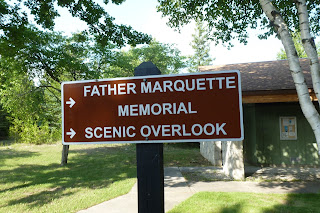
The footprints of the early French and the Society of Jesus, or Jesuits, are all over the Straits of Mackinac and Michigan's Upper Peninsula. One of their most famous is Fr. Jacques Marquette, missionary, explorer, and mapmaker. He founded missions to the native Americans at Sault Ste. Marie in 1668 and another at St. Ignace in 1671. That was before he decided to make the 3000 mile canoe trip to explore Wisconsin, Illinois and the Mississippi River as far south as Arkansas. He died on the return trip in 1675. His grave is in St. Ignace. Wish I'd known that. Will have to visit his grave on my next trip to the Straits. I did visit the Fr. Marquette Memorial though. 
https://en.wikipedia.org/wiki/Jacques_Marquette

Thanks to Bobak Ha'Eri for this photo of Fr. Marquette's grave.


A map of Fr. Marquette's journeys is embedded in the floor of the memorial.


To learn more about the good Father here's a great bio link. 
Fr. Jacques Marquette, Dictionary of Canadian Biography
Sketch from Wikimedia Commons
We headed home the next day. Will post photos of the Forty Mile Point Lighthouse near Rogers City, (a pleasant surprise) next time. But I can't end any post about Mackinac without a mention of its most famous product, Mackinac Island Fudge.

It wouldn't be Mackinac without a little something from The Mackinac Fudge Shop
I bought a block of the Mint Chocolate chip, just to take a photo of it for this blogpost. But by the time I found my camera the entire block had disappeared, nothing left but the wrapper??? Honestly... I have no idea where that delicious fudge might have disappeared to. So I posted the link above for you Fudgies.

Vivian : )

Tuesday, July 16, 2013

VACATION AT MACKINAC PART I

The Straits of Mackinac
  
The Straits of Mackinac must be one of the most photographed places in the world. Yet no two photos are ever quite the same. Sunlight, clouds, mist, wind, change the scene from moment to moment, and tomorrow will seem entirely different from today. That's why people return year after year to the same park bench by the Mackinac Bridge.  

  Everybody's favorite bench. Best place in the world to just sit and take in an awesome view.

Had a great vacation at the Straits. Discovered some new places and events. Started with Engineers day at the Soo Locks, toured Michilimackinac again, found the Fr. Marquette Memorial in St. Ignace, and the Forty Mile Point Lighthouse on Lake Huron. 

Took hundreds of photos but don't worry, I'll only post the best ones here at The Last Lord of Paradise, starting with the good old Big Mac Bridge and Colonial Michilimackinac.  


Always changing

Lilacs in July. Mackinac has the perfect climate and soil for growing Lilacs.

One more thing I love about the Mackinac area is its long history. From the Colonial Fort Michilimackinac, set on the archeological digs of the original French fort built 1718––to Fort Mackinac on the Island, built by the British in the late 18th century, it's authentic history.  


Michilimackinac gardens

British soldier

Apothecary Rose, has an interesting history and a delightful old rose scent. 


Ste. Anne de Michilimackinac Church


Bake oven

Blacksmith

Open hearth cooking.
Today's treat, cow tongue stew.

Mending her stays. Even young boys wore these. Poor posture and Chiropractors were unheard of in 18th century.


Though I've been there many times, there's always something new to learn at Colonial Michilimackinac.

The Forty Mile Point Lighthouse and New France Discovery Center were pleasant surprises, and the Soo Locks Engineers Day...a Boat Nerd's dream. (Took a great video.) Will post more soon. Thanks for stopping by.

Vivian :)


Monday, April 22, 2013

DETROIT MICHIGAN DUSK


Happened to catch the webcam on Belle Isle at just the right moment last Saturday evening. My thanks to The Dossin Great Lakes Museum, and the Detroit Historical Society for these great photos. 
http://detroithistorical.org/dossin-great-lakes-museum/detroit-river-watch-webcam

Ambassador Bridge to Canada. Windsor Ontario is on the left.


The Detroit River makes a sharp bend toward the West. This makes Detroit the only place in the US where Canada is to the South. If you're doing genealogy research about the old French settlers don't be confused. If the records state birth or death place as the South shore, they are referring to the Canadian side of the river.


Vivian :)


Tuesday, April 9, 2013

DETROIT AND ITS NAIN ROUGE

 The Nain Rouge–The Red Devil of Detroit

This past March 25th, the people of Detroit Michigan gathered together. Their objective? To chase the Nain Rouge from the streets of their town. http://marchedunainrouge.com/gallery/  

Nain Rouge?  you ask. What's that? The name translates from French as Red Dwarf and the reason this guy hangs around Detroit goes back to its founder Antoine de la Mothe Cadillac who built Fort Pontchartrain on the banks of the Strait in 1701.  
Elves, dwarves, trolls, and even the Irish Leprachauns-- history is full of these mythical creatures, all of whom crave flattery, and are quick to be offended. The story of the Nain Rouge came to us from ancient Normandy in France. He is a a lutin or imp, a small, mischievous devil or sprite.
http://en.wikipedia.org/wiki/Nain_Rouge

The French brought these old stories with them to the New World and the shores of the Detroit River and passed them down the generations.

One of the best versions of Detroit's Nain Rouge story is found in Legends of Le Détroit, by Marie Caroline Watson Hamlin. First published in 1883, the author claims in the book's introduction to have heard some of these stories from "the aged lips of ancestors who's memories extend into the last century." It's a great book, written in a lyrical style. My kids enjoyed it's strange tales too. It can be found in Google books. Legends of Le Détroit

On page 27 in this collection of old Detroit myths and legends a footnote describes the Nain Rouge as "... the demon of the Strait ... Most malignant if offended but capable of being appeased by flattery."

Mrs. Hamiln  describes a party in 1701 at the Castle of St. Louis in Quebec City, home of the French Governor of New France. Antoine de la Mothe Cadillac is enjoying himself with the dignitaries of New France. After years as a successful Commandant of Michilimackinac he now revels in his plans to found a new post on "the Strait" between Lake Huron and Lake Erie.

A fortune teller arrives at the party and the amused guests offer their palm for her to read. They laugh  at the secrets she reveals about the guests, but when Cadillac offers his palm he says, "I have no interest in the past...tell me about the future."

The fortune teller predicts that Cadillac will found a great city. A city that will one day contain more inhabitants than New France, and it will reach a height of prosperity he could not imagine in his wildest dreams. Then she warns him to beware of his own undue ambition, that his policy of selling liquor to the Indians for furs is contrary to the wishes of the Jesuits and will ruin him.

"Be careful not to offend the Nain Rouge," the fortune teller says or your children will not see a vestige of your inhertance, and your name will be unknown in the city that you founded." The other guests go serious at her words but Cadillac laughs.  

In 1707 the settlement at Detroit is prosperous and growing. A crowd gathers before Cadillac's home  to celebrate May Day. He appears dressed in his blue uniform and cavalier hat with plumes. The crowd gets down on one knee and pledges loyalty to their Lord, the Fleur dis Lis (flag of France)  is raised and Cadillac is seated with his family on a gallery to watch the days festivities. As he watches his habitant's dance he is delighted with all he has accomplished.

When the party is over he and his wife take a twilight stroll through the Kings Garden. They cross paths with a small man with a red face and a gleaming eye. His smile reveals pointed teeth.

"It is the Nain Rouge," his wife whispers, but Cadillac strikes the man with his cane shouting, "Get out of my way, you red imp." There is a fiendish laugh as the dwarf disappears into the darkness ... and the rest is history.

That same year there is an investigation into Fort Ponchatrain's management. Cadillac is accused of selling liquor to the Indians, and falsifying the number of permanent inhabitants at Detroit. In 1709 he is called back to Montreal and arrested on charges of extortion and abuse of power. The  investigator's report is strangely similar to the headlines of today's Detroit.

"... report, submitted in November 1708, was a crushing indictment of Cadillac as a profiteer and of his policy as a menace to French control of the interior. It began by pointing out that Detroit was not the highly developed settlement which Cadillac was describing in his dispatches in order to induce the minister to separate it from Canada. Besides the military garrison and a few hundred Indians there were but 62 French settlers and 353 acres of land under cultivation. Over this domain Cadillac exercised a tyrannical rule which had earned him the hatred of white and red man alike. Tradesmen were obliged to pay him large sums of money for the right to ply their craft; a jug of brandy, which cost two to four livres in Canada, sold for 20 at Detroit."

The officials who had promoted Cadillac for so many years, hated admitting to their mistake and assigned him to a post in Louisiana, that he badly mismanaged. By 1717 officials were tired of Cadillac's drama. At his own request he was sent back to France and spent six months in the Bastille prison for publicly defaming Louisiana. He remained in France and sold all his land holdings in Detroit. At his death in 1730 only three of his thirteen children survived him.

The settlement at Detroit struggled on, often visited by that Red Dwarf. From sightings before the great fire of 1805 that destroyed the newly American city, to it's surrender to the British in the war of 1812, and even during the summer of Detroit's 1967 riots, the Nain Rouge remains a terrible urban legend that simply will not go away.

Unless of course he is routed out by Detroit's own citizens. 


Friday, March 15, 2013

MY MOTHER WAS RIGHT


Remember being a kid––a teenager old enough to remember things?  Remember how your mom or dad told you stories about the past, and being a teenager you automatically dismissed their stories because… well just because. They were your parents after all, ancient as far as you were concerned, and befuddled by all that was new. You figured they must have dreamed up these stories about the past. 

Growing up near Detroit our family often crossed the Candian border to visit my mother's family near Windsor, Ontario. We always passed a certain house on the road. My grandparents had lived there… eons before, but Mom always told me the same story about that house. My Irish Great Grandfather, his  American wife and three daughters, lived in that home for a time, when he worked for a salt mine nearby. 

One day a horse drawn wagon loaded with vegetables passed by that house, headed for the ferry boat and the farmer's market in Detroit. The youngest daughter flagged down the driver hoping to buy some vegetables. She ended up married to that French Canadian farmer and they had three daughters of their own. The oldest was my Mother. 

It was the story of how I might have been a Canadian, but my mind was only concerned with the Beatles song playing on the car radio. 

When Mom said my French Grandfather's ancestors were farming along the Detroit River three hundred years ago, that they lived there with the Indians, I laughed.

There was the story of how Mom became a replacement blind date. It was an outing set up by a mutual friend of my father. Her sister was supposed to go but she fell ill at the last minute. It was the Great Depression and few people had phones, so Mom was recruited to fill out the quartet. My mother went along in her sister's stead to meet the young stranger waiting at the other end of the Detroit-Windsor Tunnel. A year later they were married, and I was born an American.

There were other stories––a cousin who worked at the Pentagon for many years, my paternal Grandfather's successful upholstery business. And there were babies –– babies that died of Diphtheria and influenza, of food poisoning due to lack of refrigeration, a sister killed by an accidental gunshot. I heard the stories but they did not penetrate my frivolous teen aged heart. 

It wasn't until I threw a high school graduation party for my own daughter, that I gave a second thought to Mom's stories. My daughter asked me who all those well wishers were at our house. I could name the first even the second cousins, but then she wanted to know more. At eighteen, her mind was far more curious than mine and we began to gather family information.  

My parents were gone by then. My mother and grandmother's photo albums contained people I did not recognize. I recalled the many names Mom mentioned over the years but I'd no idea how or if we were related. 

We had the internet though, and we began to research, amazed at how many others were seeking their family too.  Our family website was contacted by my mother's cousin––the man who worked at the Pentagon. We met with him, and this time I listened to the stories––Stories about that Irish Great Grandfather, stories about the fun times he'd had visiting my mother's farm as a child. Even at ninety years old he could identify many of our old photos. He was in several of them. 

Then a kindly Canadian saw our family website. My 5th cousin, he sent me a database of 1500 names gleaned from church records in Windsor and Quebec. I sat up all that night totally spooked as generation after generation clicked by on the computer screen.  My mother was right, her French Canadian family not only went back to the beginning of Detroit, they went back to the first settlers in North America. One of them was an interpreter of Indian languages. 

Historical research proved that yes there was a Windsor Salt company near Windsor at the turn of the 20th century. And a business card in my mom's things confirmed my grandfather's Detroit upholstery business. 

I told the story of my parent's accidental blind date to my cousins (children of the ill sister) and our minds boggled with what ifs. 

I stared at the headstones of children lost in infancy, of a sister lost to a misfired gun, and felt my ancestor's loss, as I thanked God for the life we have today. 

My mother was right, right about everything. In my mind I've apologized many times for dismissing her stories. I just wish she was here now. There are still so many questions. 


Thursday, February 14, 2013

THE JESUITS, AND MY OLD PEAR TREE


Decades ago my husband and I bought our first home. It was located near Lake St. Clair where the early French first settled, but I had little knowledge of them at the time. We were young, first time home buyers. It was May. The first home we looked at greeted us with a cloud of fragrant pink and white blossoms in the backyard. Enchanted by an orchard of apple, plum, and a single pear tree, we bought the place on the spot.

The apples we soon discovered were riddled with worms. No matter how much or how often we sprayed those apple trees, we could not defeat the little buggers. Apples fell to the ground, deformed and inedible––food for the birds and bees and insects, until we raked them into a garbage bag and sent them to the curb on trash day. Then the plum tree was overtaken by some kind of grasshopper and had to come down.
The pear tree however, was awesome. Not a bug to be found. Withstanding Michigan's extreme heat and cold, without spray, extra water or fertilizer or pruning, it bloomed into white blossoms that produced bushels of tasty ripe pears every August.
We left that house many years ago, but after researching my Last Lord of Paradise book series about the early Michigan French, I started thinking about that pear tree. Could it have been a descendant of the Jesuit Pear trees––Trees planted more than 200 years ago by Jesuit priests with seeds brought from France? Some experts call the Jesuit Pear trees a legend, they say that the orchards were simply planted by the French habitants...But others do not agree. 

According to an article in Botanical Electronic News from 2008, Cultivated Pears in Canada: Past & Present, the first pear trees in North America were planted by Jesuits.

"Pears originated in Asia, and are believed to have been cultivated for thousands of years. Although three species are cultivated in Canada, there are no native North American species. The "Common Pear," Pyrus communis, was introduced during the very early stages of settlement. The first trees were planted as crops in the early 1700s in the eastern Canadian wilderness. These early pears came from France and are now called "Jesuit Pears" or "Mission Pears" because they were planted by Jesuit priests in orchards at the missions and forts in Nova Scotia, Prince Edward Island, along the St. Lawrence River, the Niagara River and particularly along the Detroit River."http://www.ou.edu/cas/botany-micro/ben/ben386.html

The Jesuit Relations, a seventy volume set of journals and letters written by the Jesuits, shows their interest in the possibilities of agriculture and fruit trees in New France.

In Volume I, 1610 they write about the Native's agriculture, and that Port Royal on the Atlantic Ocean does not contain much fruit, but they have hopes that one day it will yield all that France yields.

"They also have excellent hemp, which grows wild, and in quality and appearance is much superior to ours. Besides this they have Sassafras, and a great abundance of oak, walnut, plum and chestnut trees, and other fruits which are unknown to us. As to Port Royal, I must confess that there is not [19] much fruit there; and yet the land is productive enough to make us hope from it all that Gallic France yields to us."
http://puffin.creighton.edu/jesuit/relations/relations_01.html

Vol. VI of The Jesuit Relations shows a letter dated 1634 from Quebec, written by Fr. Paul le Jeune, to his superiors in France. It confirms the Jesuits experimented with planting fruit trees.

"As to the fruit trees, I do not know how they will turn out. We have two double rows of them, one of a hundred feet [148] or more, the other larger, planted on either side with wild trees which are well rooted. We have eight or ten rows of apple and pear trees, which are also very well rooted; we shall see how they will succeed. I have an idea that cold is very injurious to the fruit, but in a few years we shall know from experience." [page 75]
http://puffin.creighton.edu/jesuit/relations/relations_06.html

By 1736 they write of Detroit and how well fruit trees grow there.
Vol. LXVIII

FOUR LETTERS TO FATHER BONIN

1735-1736

"Detroit, at the forty-second degree of Latitude, is situated between Lake huron, and Lake hérié This stretch of country is the Finest in canada; there is scarcely any winter, and all kinds of fruit grow there as well as they do in france."
http://puffin.creighton.edu/jesuit/relations/relations_68.html

The French of old Detroit called their orchards the Apostles, because they planted their pear trees in rows of twelve with the Judas tree set separate from the rest. 


There was a well known group of these "Apostles" in Detroit's Waterworks Park. The last one, pictured above, had to be taken down in 1938. But descendants still dot the landscapes of Grosse Pointe, Downriver, and Windsor Ontario, and the Canadians are intent on preserving the species. 

In the Encyclopedia of French Cultural Heritage in North America, Marcel Bénéteau of University of Sudbury, Ontario tells us about these remaining ancient giants.

"One venerable specimen, located near Harrow, Ontario, estimated to be over 200 years old, is 12 metres (40 ft) high with a trunk measuring 5.7 metres (18.7 ft) in circumference. Others found in Windsor and in the village of Rivière-aux-Canards have nearly reached such colossal dimensions. Despite their great age and their sometimes very advanced state of decay, most of these trees still produce, year in and year out, a large number of tiny, sweet, slightly spicy pears.Their rather more round than pear-shaped fruit ripens in mid-August."

"... During the 300th anniversary celebrations of the founding of Detroit, a group of area French speakers founded a tree nursery, in order to provide pears anyone interested in propagating the
species."

There are also some great photos of these old trees with Marcel Bénéteau's article. http://www.ameriquefrancaise.org/en/article-317/Jesuit_Pear_Trees.html

Ok, so maybe my pear tree wasn't 200 years old. But the fruit looked like the Common Pears pictured above, and the tree looked like the ancient one in Detroit's Waterworks Park.
I can still wonder. :)

Vivian

PS. I liked the story of the Jesuit Pear trees so well that I included an orchard of "Apostles" in The Last Lord of Paradise.
http://amzn.to/OHrGEK